How to Turn Website Visitors Into Leads | Demand Cadence
A website should do more than look professional. Learn how small businesses can turn website visits into calls, WhatsApp messages, enquiries, and real opportunities.
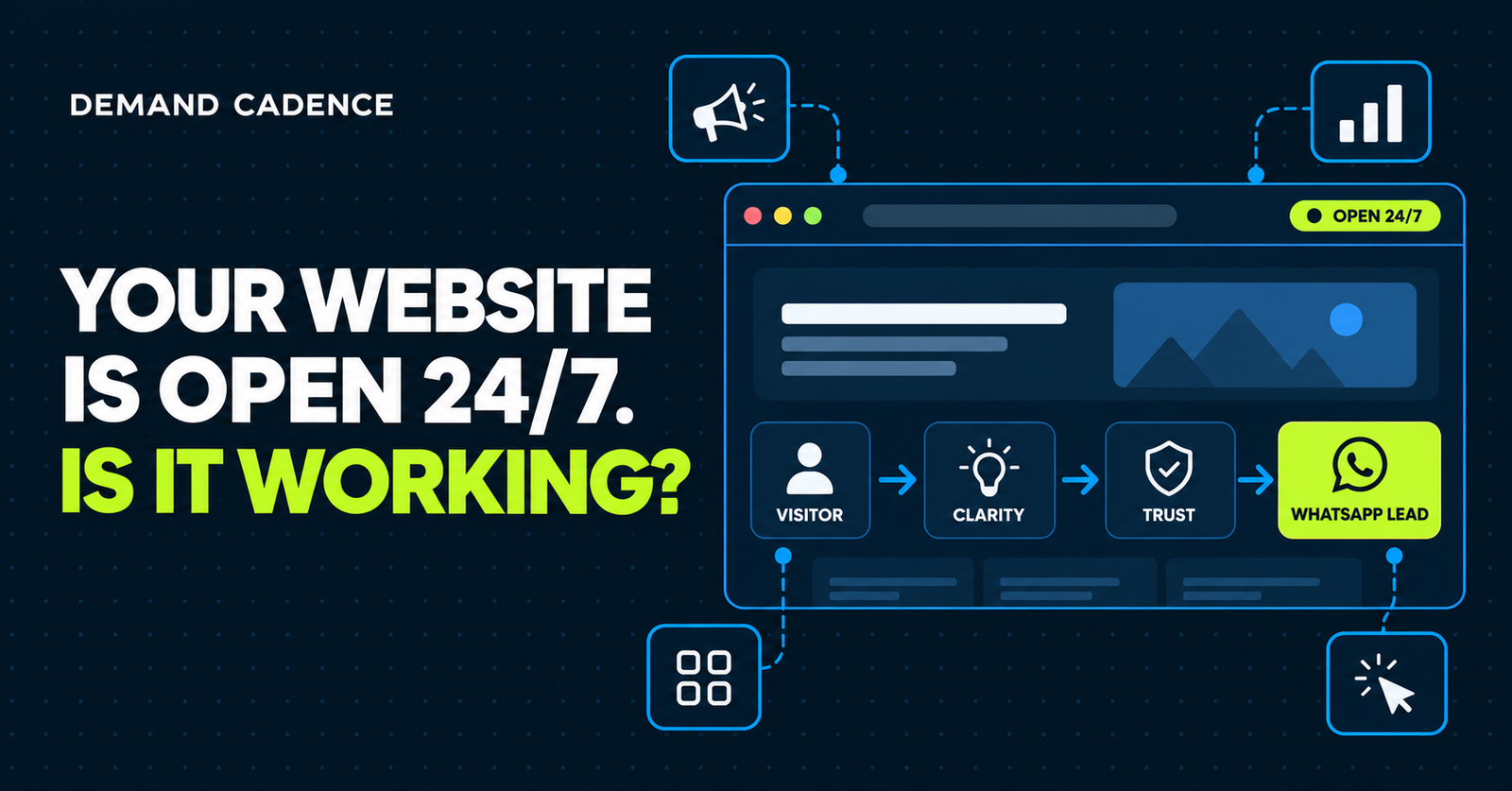
Your website may be open every hour of every day.
But is it working like a salesperson-or sitting there like a brochure?
For many small businesses, a website is built once, shared a few times, and then forgotten. It may look professional, list a few services, and include a contact form.
Yet it does not bring enquiries.
The problem is not always traffic. Sometimes, the real issue is that visitors do not understand what the business offers, why it matters, or what they should do next.
A strong website should not leave people thinking:
“This looks nice.”
It should leave them thinking:
“This is exactly what I need. Let me contact them.”
Your website has one job: move visitors forward
A visitor does not need to know every detail about your business on the first screen.
They need clarity.
Within a few seconds, they should understand:
- What you offer
- Who it is for
- What problem it solves
- Why they should trust you
- What they should do next
If those answers are unclear, people leave—even if your product or service is excellent.
This is why a website is not only a design project. It is a communication and conversion tool.
Start with a message people understand immediately
Many websites open with vague lines such as:
- “We deliver excellence.”
- “Your trusted partner.”
- “Innovative solutions for tomorrow.”
These phrases sound professional, but they do not explain anything.
A better headline tells visitors what you do in plain language.
For example:
- “Social media marketing and video ads for businesses ready to grow.”
- “Solar solutions designed around what needs to stay on.”
- “Website design that helps small businesses get more enquiries.”
- “Professional interior services for spaces that need to feel like home.”
Clear beats clever when a customer is deciding whether to stay or leave.
Give every page one clear next step
A website can lose potential leads when it gives visitors too many choices—or no clear choice at all.
Every important page should have one primary call-to-action.
That could be:
- Message us on WhatsApp
- Request a quote
- Book a consultation
- View our services
- Call now
- Get availability
- Start the conversation
The call-to-action should be visible, specific, and easy to understand.
“Submit” is weak.
“Get a Free Website Review” is clearer.
“Message Us for Product Availability” is more useful.
The best call-to-action matches the visitor’s stage of decision-making.
Make trust visible
People do not only buy a service or product. They buy confidence.
Your website should show reasons to trust your business.
That can include:
- Clear business contact details
- A physical address, if relevant
- Recent work or portfolio samples
- Customer reviews or testimonials
- Product brands you offer
- Frequently asked questions
- Before-and-after examples
- Clear service processes
- Professional photographs and visuals
Trust is especially important for businesses selling high-value products, professional services, home solutions, or technical work.
If a visitor cannot quickly see who you are, what you have done, or how to contact you, they may choose a competitor that feels easier to trust.
Mobile experience is not optional
Most people will first see your website on a phone.
That means your website should be easy to use with one hand, quick to scan, and simple to contact from.
On mobile, make sure:
- Text is easy to read
- Buttons are large enough to tap
- WhatsApp and call buttons are visible
- Forms are short
- Images do not slow down the page
- Important information appears near the top
- Navigation is simple
A website that works beautifully on a laptop but feels difficult on a phone will lose potential customers.
Do not make visitors search for the answer
A visitor should not have to search through five pages to find a price range, service description, location, product category, or contact method.
Make the important information easy to find.
For service businesses, include:
- What you do
- Who you help
- How the process works
- What makes your approach different
- How to get started
For product businesses, include:
- Product categories
- Key benefits
- Availability guidance
- Delivery or installation details
- Easy enquiry options
The easier it is to understand your business, the easier it is to choose it.
Measure what happens after the click
Website traffic is useful—but traffic alone is not success.
A hundred visitors who do nothing are less valuable than ten visitors who message, call, request a quote, or book a meeting.
Track actions such as:
- WhatsApp clicks
- Phone calls
- Contact-form submissions
- Quote requests
- Booking requests
- Product enquiries
- Downloads
- Time spent on key pages
These actions tell you whether your website is helping the business move forward.
If people visit but do not contact you, the message, offer, page structure, trust signals, or call-to-action may need improvement.
Your website should work with your marketing
A website becomes more powerful when it connects with your wider marketing.
Your social-media posts can send people to a service page.
Your Meta ads can lead visitors to a focused offer page.
Your blogs can help people find your business through search.
Your WhatsApp button can turn curiosity into an immediate conversation.
That is how a website becomes part of a growth system—not just an online business card.
Build a website people can act on
A good website does not need to be overloaded with animations, complicated language, or pages nobody reads.
It needs a clear message, strong visual hierarchy, trust, and an easy next step.
Demand Cadence helps businesses build digital foundations that are easier to find, easier to understand, and easier to contact.
From website development and landing pages to social-media marketing, graphic design, video editing, SEO, and Meta advertising, we help connect your online presence to real business goals.
Your website is already open 24/7. Make sure it knows what to say.
Frequently asked questions
How can a website generate leads?
A website can generate leads by clearly explaining the offer, building trust, giving visitors a direct call-to-action, and making it easy to call, message, request a quote, or submit an enquiry.
What is a website call-to-action?
A call-to-action is the next step you want a visitor to take, such as “Message Us on WhatsApp,” “Request a Quote,” or “Book a Consultation.”
Does a small business need a website if it already has social media?
Yes. Social media is important for discovery and engagement, while a website gives your business a professional home where you control the message, organise services, build search visibility, and guide visitors toward an enquiry.
How do I know if my website is working?
Track meaningful actions such as WhatsApp clicks, calls, contact-form submissions, quote requests, bookings, and product enquiries—not only total page views.